Two hours or two minutes

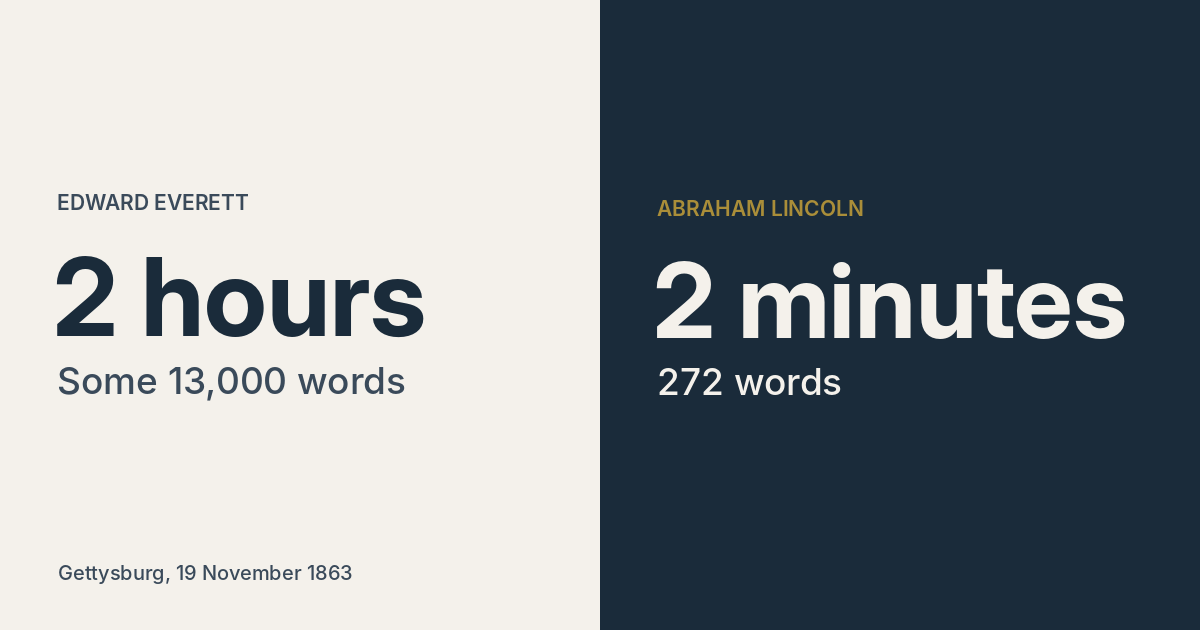
On 19 November 1863 the main speaker at the dedication of the national cemetery at Gettysburg talked for two hours. He was Edward Everett, former senator, former president of Harvard and the most celebrated orator in America. He delivered some 13,000 words from memory.
Can anyone quote a single line of it?
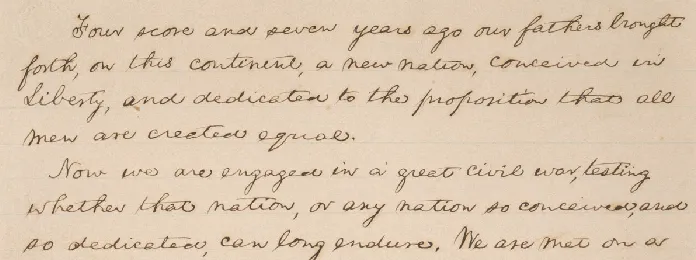
The next speaker was President Abraham Lincoln, who had been invited to offer "a few appropriate remarks". Lincoln spoke 272 words in a little over two minutes. People still recite them in full.
Lincoln's language is not what we would call plain English today. "Four score and seven years ago" is a long way round to 87. He asks us to dedicate, consecrate and hallow. A modern editor would query all of it. Yet the speech has outlasted almost everything else said in that war.
The central idea
Everett understood why. The next day he wrote to Lincoln:
I should be glad if I could flatter myself that I came as near to the central idea of the occasion in two hours as you did in two minutes.
That is the lesson. It is not about length. Everett's speech was a learned history of the battle, with comparisons to Marathon and the Wars of the Roses. Every part of it could be defended. None of it was the point. Lincoln had decided what the occasion meant and said only that.
Short did not win the front page
It is tempting to think Lincoln kept it short so newspapers would print it whole. The record does not support that. Papers printed Everett in full as well, and the Cincinnati Gazette gave him page one while Lincoln's remarks appeared on page three. Brevity did not even guarantee accuracy. The Associated Press version had Lincoln dedicating the living to "the refinished work".
What brevity gave Lincoln was memory. A reader can hold 272 words in their head. They can repeat them, copy them out and teach them. Nobody can do that with 13,000. Lincoln even predicted the opposite: "The world will little note, nor long remember what we say here." He was wrong about his own words and right about Everett's.
Most finance reports are like Everett's speech
We write the full history of what we have done. We explain every variance. We set the decision in its context going back several budget rounds. Each paragraph is accurate and defensible, and the reader finishes without knowing what we want them to do. The problem is not that the report is long. It is that we never found the central idea, so we wrote everything instead.
Cutting does not fix that. Cut Everett’s speech by half and you get 6,500 words without a central idea. The work comes before the writing: deciding what the report is for.
Try this on your next report
Before you write anything, write the central idea in one sentence. If you cannot, you are not ready to write. If you can, every paragraph that follows either supports that sentence or goes.
Then ask whether your reader could repeat your point to a colleague without looking at the page. That is the test Lincoln passed and Everett failed.